I ask owners this one a lot, usually right after a rough month: “If every dollar of income stopped today, how long could you keep the lights on?” Most people guess. A few say “I don't actually know” out loud, which I respect more than a confident wrong answer. Almost nobody has the real number ready, because it's not a number anyone hands you — it's one you have to build on purpose.
Here's the thing about that number: it's not about being afraid of a worst-case scenario. It's about never being surprised by an ordinary one. Slow months happen to every service business. The question is whether a slow month is a Tuesday or a crisis, and that entirely depends on whether you already know your runway before you need it.
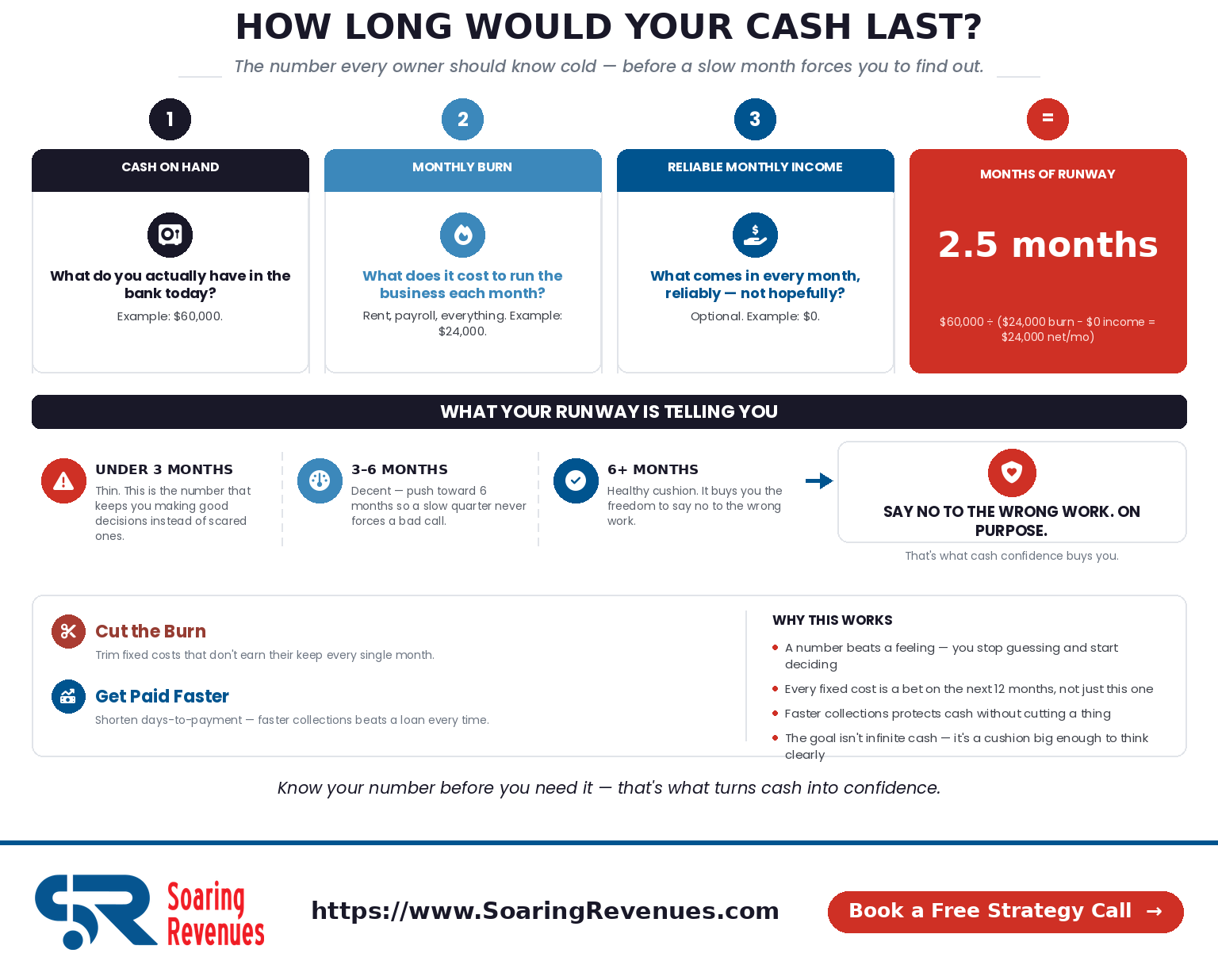
The math is three numbers, and I want you to actually run yours, not just nod along. Take your cash on hand today. Subtract your reliable monthly income — the money you can actually count on, not the money you're hoping for — from your monthly burn, everything it costs to run the business each month. That gap is your net burn. Divide your cash by that net burn, and you get your runway in months. A common example: $60,000 in the bank, $24,000 a month to run things, no reliable income to offset it. That's $60,000 divided by $24,000, and the answer is 2.5 months. Sit with that one too — it's thinner than it feels when the bank balance still shows a comfortable-looking number.
Once you have your number, here's what it's actually telling you. Under three months is thin — and I don't say that to scare you, I say it because that's the number that keeps you making good decisions instead of scared ones. Three to six months is decent ground, and the move from here is to keep pushing toward six so a slow quarter never forces a bad call. Six months or more is a healthy cushion, and what it actually buys you isn't just safety — it's the freedom to say no to the wrong work, because you're not negotiating from panic.
There are really only two levers here, and I want to be honest that neither one is glamorous. You can cut the burn — trim the fixed costs that don't earn their keep every single month, the subscriptions and commitments that made sense at a different size of business. Or you can get paid faster — shorten the days between doing the work and getting paid for it, because faster collections protects your cash without cutting a single thing. Most owners reach for a loan before they've tried either one, and a loan is almost always the more expensive fix.
What this looks like in a real business
An events and catering business had a runway number that looked fine on paper in their busy season and dangerously thin every January and February. The fix wasn't more sales — it was building a cash reserve during the busy months specifically sized to cover the predictable slow ones, instead of treating each season like its own emergency.
A staffing agency carried enormous swings in monthly burn because payroll moved with how many placements were active, and the owner had never separated “what we owe no matter what” from “what scales with revenue.” Once fixed costs and variable costs were split out, the real runway number turned out to be much healthier than the scary blended one they'd been guessing at.
A solo marketing consultant had decent cash on hand but terrible days-to-payment — clients routinely paid 45 to 60 days out. Getting paid faster, through deposits and shorter terms, added more effective runway in a quarter than months of frugal spending had.
The examples above are illustrative composites built from patterns Coach Tarek sees across clients, not individual case studies.
Run your own three numbers below — it takes less than a minute, and it's the kind of number that's uncomfortable to calculate and even more uncomfortable not to know. If yours comes back under three months, that's not a verdict, it's a starting point.