Here's the moment I want to name, because almost nobody names it out loud: you hit a goal — real revenue, a stronger team, systems that finally hold — and instead of feeling settled, you feel more overwhelmed than before. New hires need managing. Bigger cash flow means bigger cash flow problems. The thing that worked at $500K doesn't work at $1.5M.
You didn't do anything wrong. You grew. And growth, every single time, hands you a new set of problems sized to match it.
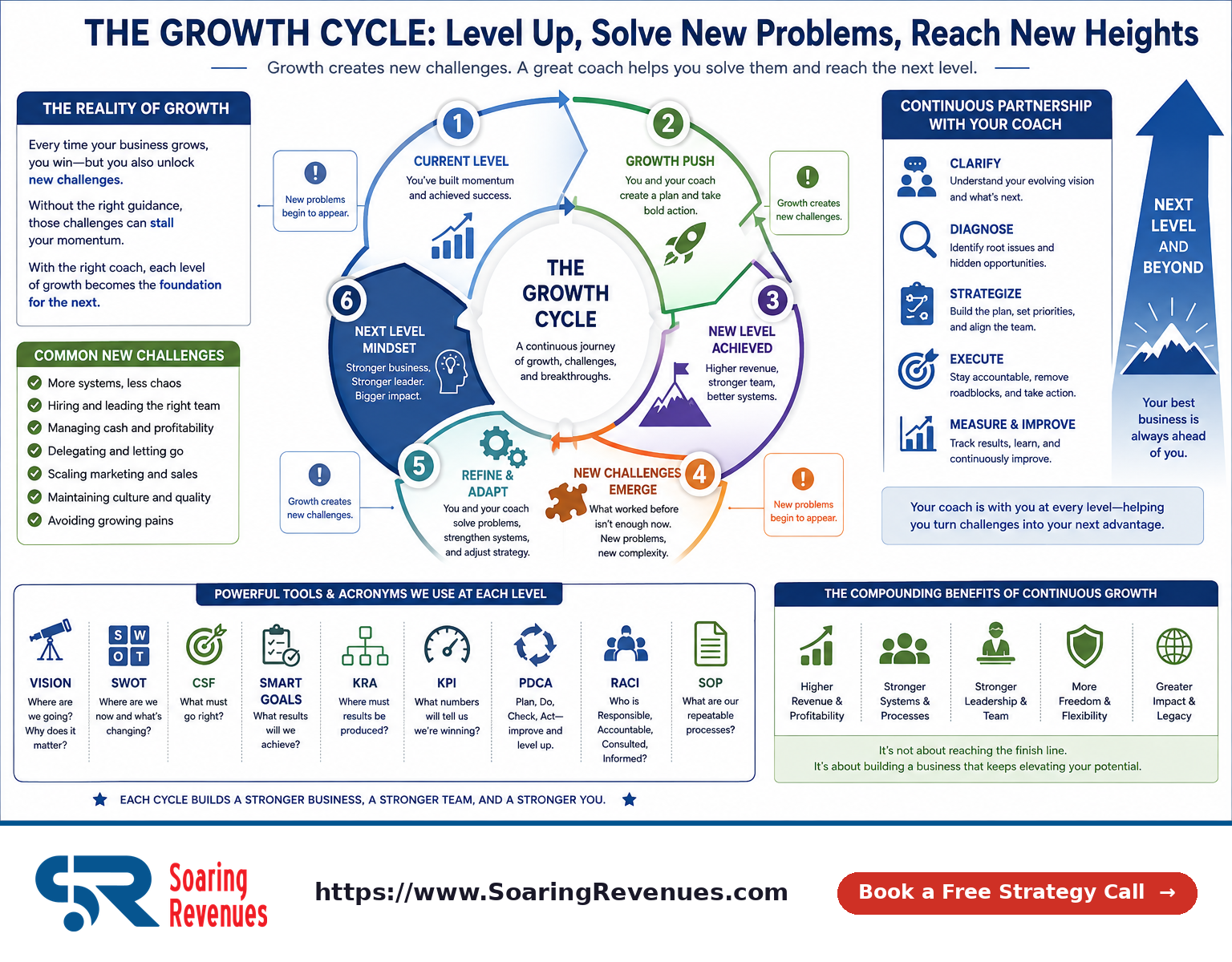
The Growth Cycle is how I help owners see that pattern instead of getting flattened by it.
1. Current Level. You've built real momentum. Something worked, and worked well enough to get you here.
2. Growth Push. You and I build a plan and take bold, deliberate action — not busywork, a specific push toward the next level.
3. New Level Achieved. Higher revenue, a stronger team, better systems. This is the part everyone celebrates, and should.
4. New Challenges Emerge. And right on schedule — because growth creates new challenges — what worked before isn't enough anymore. This is the step owners mistake for failure. It isn't. It's the toll for the last win.
5. Refine & Adapt. Together, we solve the new problems, strengthen the systems that are straining, and adjust the strategy for where the business actually is now, not where it was a year ago.
6. Next Level Mindset. A stronger business. A stronger leader. Bigger impact. And then — because this is a cycle, not a finish line — it starts again at a new current level.
The common new challenges I see, almost without exception: more systems and less chaos needed at once, hiring and leading a real team for the first time, managing cash and profitability at a size that doesn't forgive guessing, delegating and actually letting go, scaling marketing and sales past word-of-mouth, protecting culture while headcount grows, and just generally absorbing growing pains that nobody warned you about.
What this looks like in a real business
A boutique marketing agency I think about grew from three people to eleven in under two years. Every “new level achieved” moment — a bigger client, a bigger team — was followed almost immediately by a “new challenges emerge” moment: account handoffs slipping through the cracks, no one owning quality control anymore. That's not a leadership failure. That's step four, right on schedule.
A home-services company (think HVAC, electrical, plumbing) hit a revenue level where the owner's instincts, which had built the whole business, stopped being enough — the systems that worked at 6 trucks broke at 14. Refine & Adapt, for them, meant building dispatch and scheduling systems for the first time, not working harder at the old way.
A med spa owner told me the growth cycle finally explained something she couldn't name: every time she felt like she was failing, she was actually succeeding — she'd just leveled up into a harder set of problems. Naming it took the shame out of it, and shame was the thing actually slowing her down.
The examples above are illustrative composites built from patterns Coach Tarek sees across clients, not individual case studies.
If you can look at this cycle and immediately point to which step you're standing in right now, you already know more than you think. Grab the chart below, and if step four is where you are — new challenges, no clear plan yet — let's talk about what refine and adapt looks like for you.