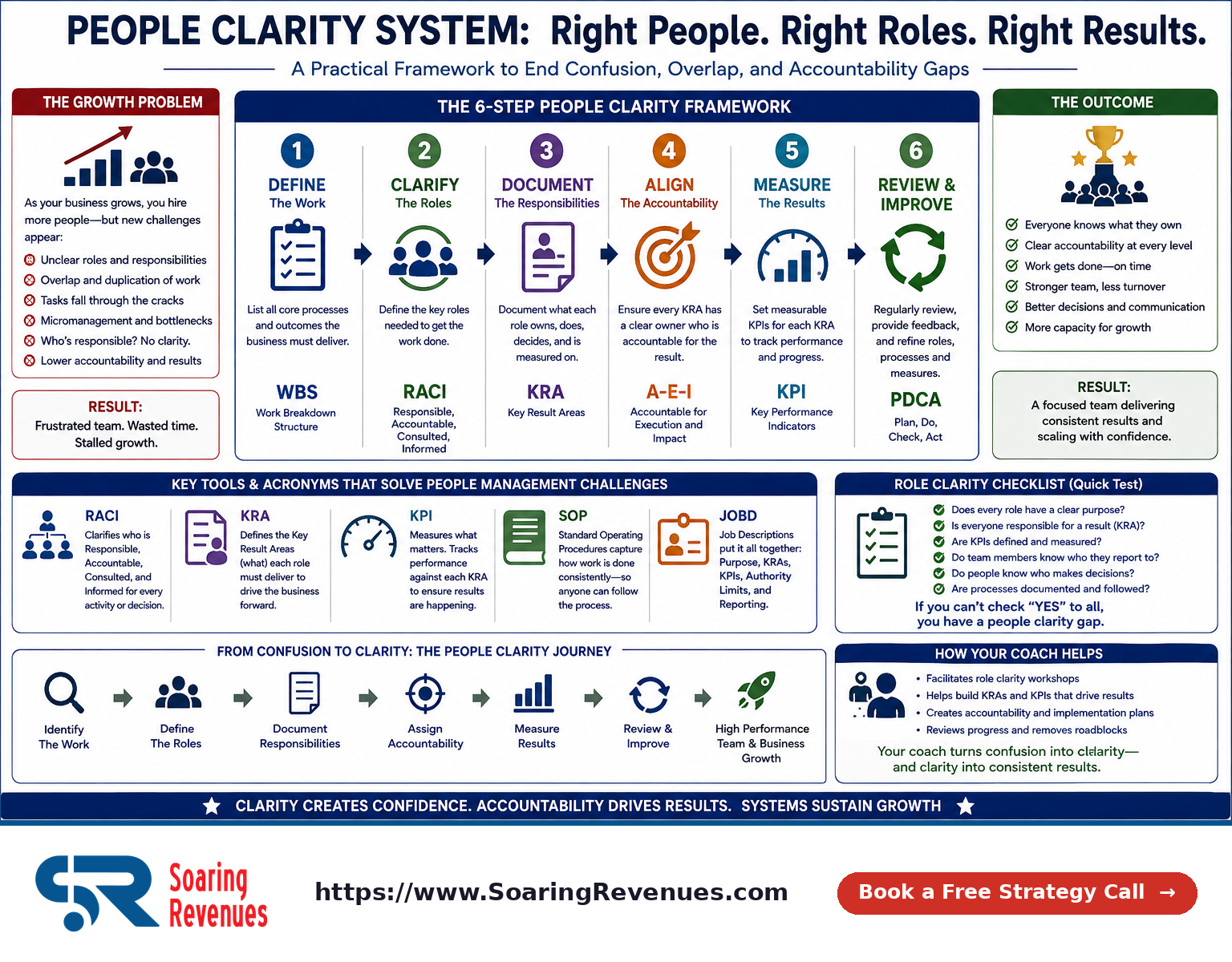
Here's a quick, honest test. Does every role in your business have a clear purpose? Is every person responsible for a specific result? Do your team members know who they report to, who makes which decisions, and whether the process they're following is actually written down anywhere? Most owners I meet can't check “yes” to all of it — and that gap, quietly, is where confusion, duplicated work, and dropped balls all come from.
It's not a hiring problem. It's not even always a training problem. Most of the time, it's a clarity problem — and it grows in direct proportion to how fast your business grows. Fewer employees can survive on instinct and hallway conversations. More employees can't.
The People Clarity System is six steps, in order, and each one depends on the one before it.
1. Define the Work. List all the core processes and outcomes the business actually has to deliver. This uses a Work Breakdown Structure — not corporate jargon, just an honest list of what actually needs to happen.
2. Clarify the Roles. Define the key roles needed to get that work done, and who's Responsible, Accountable, Consulted, and Informed (RACI) for each piece.
3. Document the Responsibilities. Write down what each role owns, does, decides, and is measured on — as a Key Result Area. If it's only in your head, it isn't documented.
4. Align the Accountability. Every KRA needs a clear owner who is accountable for both execution and impact — not just doing the task, but owning whether it actually worked.
5. Measure the Results. Set measurable KPIs for each KRA so performance and progress are visible, not assumed.
6. Review & Improve. Regularly revisit roles, processes, and measures, and refine them. This is PDCA applied to your people systems specifically — a habit, not a one-time cleanup.
Underneath all six sits the tool that pulls it together for each person: a JOBD, a job description that actually does its job — purpose, KRAs, KPIs, authority limits, and reporting, all in one place, so “what am I supposed to be doing” has a real answer.
What this looks like in a real business
A cleaning and janitorial services company had six team leads who each thought a different person owned client complaints. Nobody was wrong, exactly — nobody had ever been told. One afternoon spent on step 2 (Clarify the Roles) and step 4 (Align the Accountability) closed a gap that had been quietly costing them clients for over a year.
A small law firm had beautifully documented processes — step 3 done well — but no KPIs attached to any of it, so nobody could tell if the process was actually working or just existing. Adding step 5 turned their SOPs from paperwork into an actual management tool.
A multi-location dental practice found their bottleneck wasn't at the front desk, where they assumed — it was that the office managers at each location had overlapping authority on scheduling decisions, with no one clearly accountable when two locations made conflicting calls. Step 4 alone — a clear owner for scheduling — fixed what felt like a training problem but was really a clarity problem.
The examples above are illustrative composites built from patterns Coach Tarek sees across clients, not individual case studies.
Run the checklist on this chart against your own team, honestly. If you land on more than one “no,” that's not a crisis — it's just where you start.