Here's a question I ask almost every new client, and it usually gets a long pause: “How much did your business actually keep last month?” Not revenue. Not what came in. What you kept, on purpose, as profit. Most owners can't answer that, because their bank balance is one pile of money doing five jobs at once — payroll, rent, taxes, growth, and whatever's left is supposed to be profit, except by the time everything else gets paid, there's rarely anything left to call profit at all.
That's not a revenue problem. It's an order-of-operations problem. And it's the single change I've watched do more for an owner's peace of mind than almost anything else I teach.
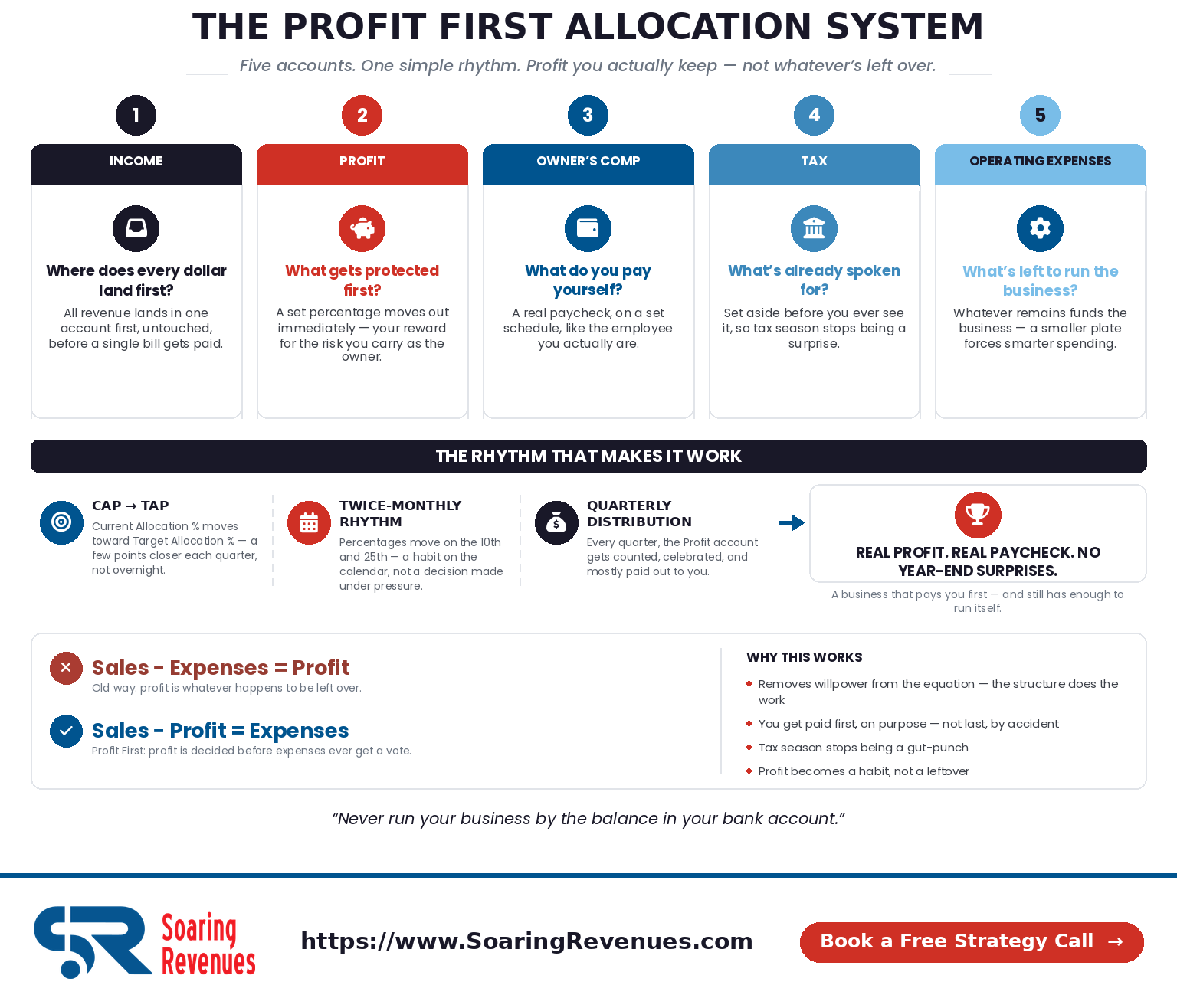
Start where you already stand: think about a paycheck. When you worked for someone else, your salary wasn't “the company's money you happened to have access to” — it was yours, set aside before anyone asked you to spend it on the business's behalf. Profit First just applies that same logic to the business itself. Instead of Sales minus Expenses equals Profit — where profit is whatever happens to survive the month — you flip it: Sales minus Profit equals Expenses. Profit gets decided first. Everything else has to fit around it, not the other way around.
Here's how the rhythm actually works, five accounts at a time.
Income. Every dollar that comes in lands in one account first, untouched. Nothing gets paid directly out of it. It's a holding pen, not a spending account.
Profit. Before a single bill gets touched, a set percentage moves out to Profit — your reward for the risk you carry as the owner, protected the way a savings deposit is protected, not left to chance.
Owner's Comp. A real paycheck, on a real schedule, like the employee you actually are. Not the last person who gets paid after everyone and everything else.
Tax. Set aside before you ever see it, so the number the IRS eventually wants isn't a surprise that wrecks your quarter — it's already sitting there, waiting.
Operating Expenses. Whatever's left runs the business. And here's the part that surprises people: a smaller plate doesn't starve the business. It forces smarter spending, the same way a smaller dinner plate quietly changes how much you serve yourself.
The rhythm that makes it stick has three parts. You measure where you are today — your Current Allocation Percentages, or CAP — against where you want to be, your Target Allocation Percentages, or TAP, and you close that gap a few points at a time, every quarter, not overnight. You move money on a fixed schedule, typically the 10th and the 25th, so it's a habit on the calendar instead of a decision made under pressure. And once a quarter, you actually count the Profit account, celebrate what's in it, and take most of it out. That's not indulgence. That's the entire point.
I want to be clear about something, because owners are hard enough on themselves already: this isn't a discipline problem. If all your money lands in one account, of course the balance runs your emotions — that's how it's built. We're not asking you to have more willpower. We're changing the structure so willpower stops being the thing holding everything up.
What this looks like in a real business
A boutique marketing agency I think about was doing over a million dollars a year and still couldn't answer “are we actually profitable?” without a call to their bookkeeper. Splitting Income from the other four accounts — just that first step — was the first time in three years the owner could look at a number and know, instantly, whether a slow month was actually a crisis or just a slow month.
A residential remodeling contractor treated every flush week as license to buy new equipment and every lean week as a reason to panic-discount the next bid. Once Operating Expenses became its own smaller account instead of a shared pile with everything else, the swings didn't stop happening — but they stopped controlling the owner's decisions, because the smaller plate made the real number impossible to ignore.
A two-person bookkeeping firm — that one stings a little, given the profession — had never once taken a formal owner's paycheck; whatever was left at year-end just accumulated in the business checking account, taxed and untouched. Setting up a real Owner's Comp account, paid twice a month like a salary, was the first time in four years the owner felt like they worked for a business instead of for whatever was left of it.
The examples above are illustrative composites built from patterns Coach Tarek sees across clients, not individual case studies.
Grab the chart below and use it as your map for setting up the five accounts, whether that's five actual bank accounts or five tracked buckets inside one. Start small — even 1% into Profit is a real start — and raise it a little each quarter. And if you look at your own numbers and can't tell me right now what your current allocation percentages actually are, that's exactly the conversation worth having.